
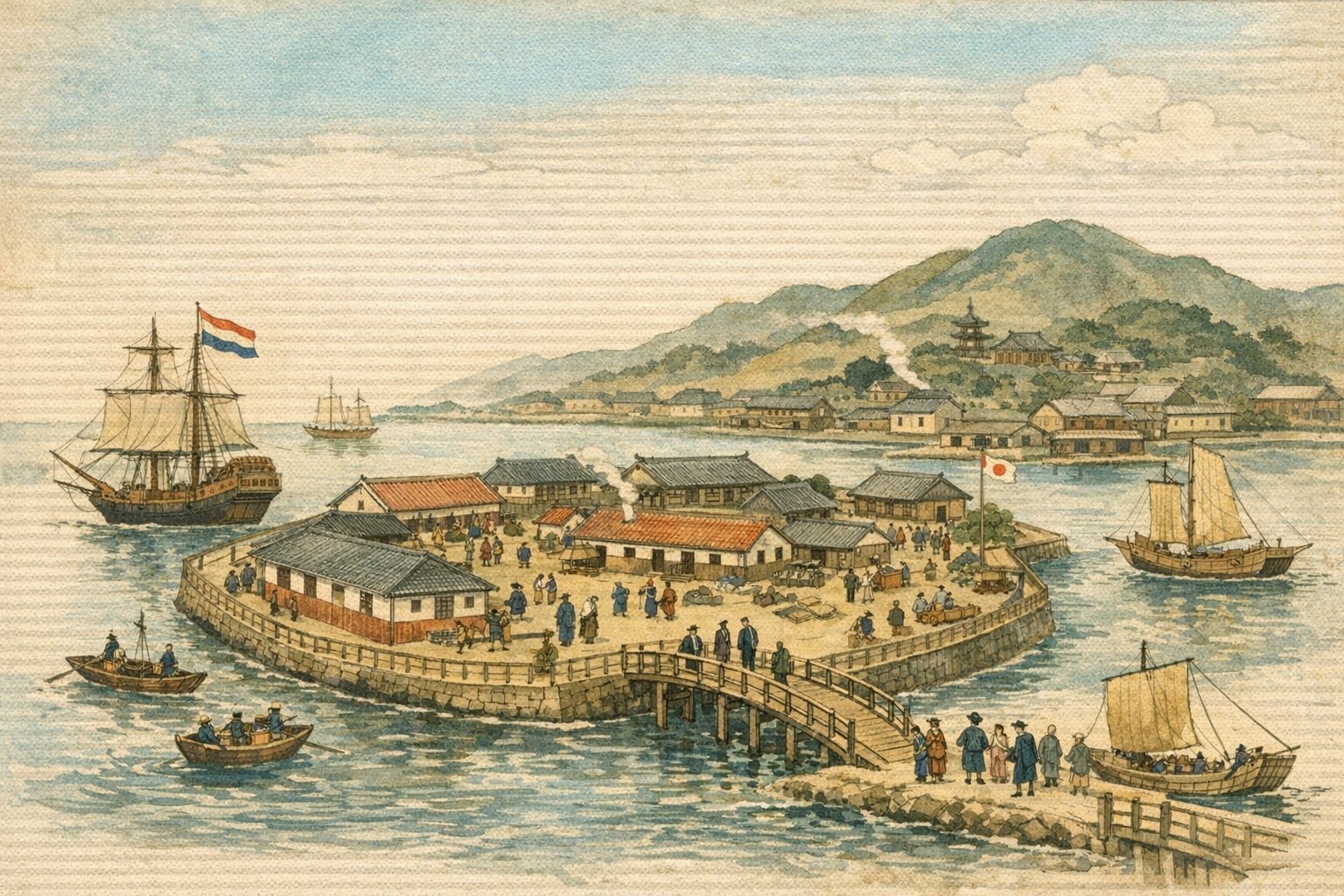
During Japan’s Edo period (1603–1868), the country limited contact with the outside world under a policy known as sakoku, or national isolation. While most of Japan was closed to foreign influence, Nagasaki remained the only official gateway through which limited international trade was allowed. At the center of this exchange was Dejima, a small artificial island built in Nagasaki Harbor in the 17th century.
A Unique Trading Post
Dejima was originally constructed in 1636 as a controlled trading post. During Japan’s isolation period, Dutch merchants were the only Europeans permitted to remain in the country, and they were required to live and conduct business within the confined space of this small island. Although tightly regulated, Dejima became an important bridge between Japan and the outside world. Through this small trading post, knowledge from Europe began to enter Japan, including advances in medicine, science, astronomy, and technology. This exchange later became known as Rangaku, or “Dutch learning.”
Cultural Exchange in Nagasaki
The presence of foreign traders also influenced the culture of Nagasaki. Western ideas, goods, and techniques slowly made their way into Japanese society through this single port city. Nagasaki developed a unique international atmosphere, where Japanese, Chinese, and European cultures met and interacted. This cultural exchange helped shape Nagasaki into one of the most distinctive cities in Japan.
Visiting Dejima Today
Today, Dejima has been carefully restored to recreate the appearance of the original trading island. Visitors can walk through reconstructed buildings, merchant houses, and warehouses while learning about the daily lives of the Dutch traders who once lived there. Standing on the island today, it is easy to imagine how this small piece of land once served as Japan’s narrow but vital window to the world.